Back
Published on October 19, 2026
Prayers to the Earth God are one of the most widely practised rites in Chinese Singaporean homes and businesses. You see them in a new BTO flat on the morning before the contractor starts hacking. You see them when a family carries the rice pail and water into a resale flat on move-in day. And you see them on the opening day of a coffee shop stall, with incense smoke rising beside the cash register.
Yet many homeowners are unsure which occasions call for prayers to earth god singapore, what offerings to prepare, or how to choose the right day and hour. This guide explains who Tu Di Gong is, when Singapore families and business owners pray to him, and how the masters at TianLu Geomancy conduct the ritual properly.
Who Is Tu Di Gong (土地公)?
Tu Di Gong, formally known as Fu De Zheng Shen (福德正神), is the guardian deity of a specific piece of land. In Chinese belief, every plot, whether a landed house, an HDB unit or a shophouse, comes under the care of a local earth deity. Before you disturb the land by building, renovating or moving in, you show respect by informing him and asking for his protection.
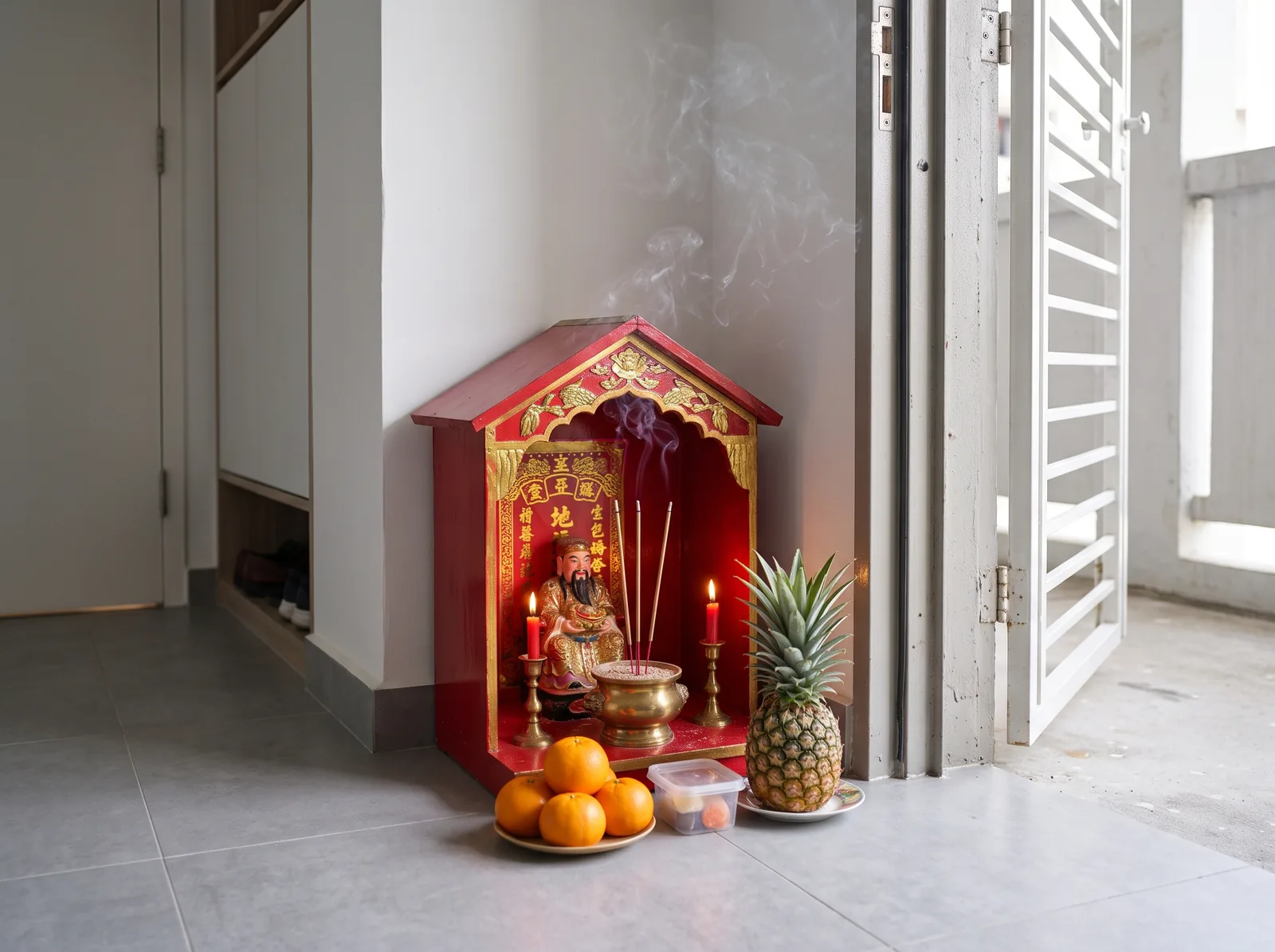
In Singapore, Tu Di Gong is closely linked with Tua Pek Kong (大伯公). The Singapore Chinese Cultural Centre notes that Tua Pek Kong is also known in Chinese as Fu De Zheng Shen, which is why so many local temples dedicated to him are called Fu De Ci (福德祠). Many Singapore homes also keep a small floor-level tablet for the landlord deity, commonly inscribed Tang Fan Di Zhu (唐番地主), which is honoured alongside or in place of a Tu Di Gong statue.
Tu Di Gong's birthday falls on the 2nd day of the 2nd lunar month. In 2027, this is Tuesday, 9 March.
When Do Singapore Families and Businesses Pray to the Earth God?
Before Renovation and Hacking Works
This is the occasion most Singaporeans know. Hacking walls, removing floor tiles and drilling all disturb the land, so earth god prayers renovation are offered before the first noisy works begin. Families believe this helps prevent accidents, delays and disputes with contractors.
There is a practical Singapore detail here. HDB only allows noisy renovation works between 9am and 5pm on weekdays, and not on Saturdays, Sundays or public holidays. Your auspicious date for the start of works therefore has to be a weekday, and the prayers should be completed before the contractor begins. For landed homes and new commercial builds, the larger version of this rite is the ground breaking ceremony.
Moving Into a New HDB, Condo or Landed Home
Moving in is the second key moment. On the move-in day, the family informs the Earth God that new occupants have arrived and asks for peace and safety in the home. The prayers are usually timed together with the auspicious date selection for the move itself, so the family enters on a good day and hour. Resale buyers often pair this with a house cleansing and blessing to clear residual energy from previous occupants.
Opening a Shop, Office or F&B Outlet
For business owners, Tu Di Gong is a guardian of both the premises and its wealth. Prayers on opening day ask for smooth business, honest customers and steady cash flow. These are usually combined with a commercial feng shui assessment of the entrance, cashier counter and facing direction.
Regular Offerings on the 2nd and 16th Lunar Days
Many Hokkien and Teochew business owners in Singapore make offerings to the Earth God on the 2nd and 16th day of each lunar month, a custom known as Zuo Ya (做牙). The first of the year, Tou Ya (头牙), falls on Tu Di Gong's birthday. The last of the year, Wei Ya (尾牙), falls on the 16th day of the 12th lunar month. This is where the familiar year-end company "wei ya" dinner gets its name. The next Wei Ya falls on Saturday, 23 January 2027. Many households, by contrast, pray on the 1st and 15th of each lunar month.
Offerings and What They Mean
The exact list differs by dialect group and by the master's tradition, so always confirm with your master before buying. The items most commonly prepared in Singapore include:
- Incense and red candles: Incense carries the family's message to the deity, while the candles bring light and warmth to the altar.
- Fruit: Mandarin oranges symbolise gold, and the pineapple is popular because its Hokkien name, ong lai (旺来), sounds like "prosperity arrives".
- Tea or wine: Usually offered in three small cups as a mark of respect.
- Sweet cakes: Huat kueh (发粿) is a favourite, as its rising shape represents growing fortune.
- Meat offerings: Larger ceremonies, such as shop openings and ground-breaking, may include roast pork or the three meats (三牲).
- Joss paper: Gold paper offerings such as Fu Jin (福金) are traditionally offered to Tu Di Gong.
Choosing the Auspicious Date and Hour
A date that the Tong Shu (通书) almanac marks as suitable for breaking ground (动土) or moving in (入宅) is only a starting point. A qualified master also checks that the day does not clash with the zodiac or Day Pillar of the homeowner and key family members, then selects the best two-hour window within that day.
Singapore adds its own constraints. The date must work with HDB or condo management renovation rules, your contractor's schedule and, for move-ins, your key collection date. Most families also avoid starting renovation or moving in during the 7th lunar month. In 2027, that month runs from 2 August to 31 August.
How TianLu's Masters Conduct Earth God Prayers
At TianLu Geomancy, Earth God prayers are conducted by Master Rayden Sim and Master Jerynna. Master Rayden was born into a feng shui family in 1969, trained under his father from childhood, and has practised independently since 1989. He was certified as a Full Professional Geomancy Master in 2002 and received the Circle of Excellence Award in 2012 as one of Singapore's Top 5 Feng Shui Masters.
A typical engagement follows these steps:
- Collect details: The master takes the birth data of the homeowner or business owner, the address, and the facing direction of the main door.
- Select the date and hour: The master cross-references the Tong Shu with the family's BaZi and fits the result to your renovation or move-in schedule.
- Advise on offerings: You receive a clear list of what to prepare, so nothing is bought unnecessarily.
- Conduct the ritual: On the day, the master sets up the offerings, announces the address and the names of the household, and asks Tu Di Gong for safety and smooth works or business.
- Close properly: Joss paper is burned only in designated burners, such as those provided by your Town Council, and never along the common corridor.
Common Mistakes to Avoid
- Choosing the date from an app alone: A generic good day can still clash with the homeowner's birth year.
- Starting hacking before the prayers: The rite should come before the land is disturbed, not after the first wall is down.
- Burning joss paper in the corridor: It is a fire risk and unfair to neighbours. Use the designated burners.
- Skipping the thanksgiving: Many families return thanks (谢土) once renovation is complete, to close the cycle respectfully.
Frequently Asked Questions
Q: Do I need Earth God prayers if my BTO renovation involves no hacking?
A: Many families still pray before carpentry and installation works begin, and again on move-in day. Your master can advise whether one combined ceremony is enough for your situation.
Q: Can I conduct the prayers myself?
A: Many households do simple monthly prayers on their own. For renovation, move-ins and business openings, a master ensures the date, hour, direction and invocation are correct for your family.
Q: Is Tu Di Gong the same as Tua Pek Kong?
A: In Singapore the two are closely associated, and both are referred to as Fu De Zheng Shen. Local temples and families may honour them together or separately, depending on their tradition.
Q: Can I perform the prayers in a condominium?
A: Yes. Check your MCST's rules on incense and joss paper first, as many condos designate a specific burning area.
Q: What is the best time of day for the prayers?
A: There is no single best hour for everyone. The auspicious hour depends on the selected date and the homeowner's BaZi.
Book Your Earth God Prayers with TianLu
Whether you are about to renovate a new BTO, move into a resale flat or open your first shop, starting with proper prayers to the Earth God shows respect to the land and invites protection for what comes next. Master Rayden and Master Jerynna will select your date and hour, guide your offerings and conduct the ritual with care. Free consultation available.
Book your Earth God prayers today:
Call 8369 0114 or WhatsApp: 9695 1938
Email: enquiry@tianlufengshui.com
Explore more at: https://www.tianlugeomancy.com/prayers-to-earth-god
References
- Singapore Chinese Cultural Centre, Culturepaedia: "Tua Pek Kong worship among the Chinese in Singapore". Available at: https://culturepaedia.singaporeccc.org.sg/social-practices/tua-pek-kong-worship-among-the-chinese-in-singapore/
- Singapore Chinese Cultural Centre, Culturepaedia: "Fuk Tak Chi temple: The temple established by the Cantonese and Hakkas". Available at: https://culturepaedia.singaporeccc.org.sg/communities/fuk-tak-chi-temple-the-temple-established-by-the-cantonese-and-hakkas/
- Housing & Development Board (HDB): Renovation guidelines for HDB flats, including permitted working hours. Available at: https://go.gov.sg/hdb-reno